Martin Svane
Article2026.01.14
Do you see payments as a backoffice function, or a strategic asset for scaling your business? If paying for your services make up the lion’s share of your customer experience, the answer should be obvious. But in a complex international payment landscape, turning that realization into actionable strategy is easier said than done. In this article, global mobility player Arrive shares how it’s done.
Martin Svane
In 2025, EasyPark Group, Flowbird Group, and Parkopedia merged into Arrive: a global mobility platform with the mission to make cities more livable. Today, the company is active in more than 90 countries worldwide, reaching around 60 million users yearly with services ranging from parking and transport to data integration, and business solutions.
Silvana Filipponi, Head of Payments Strategy, explains the crucial role of payments for Arrive:
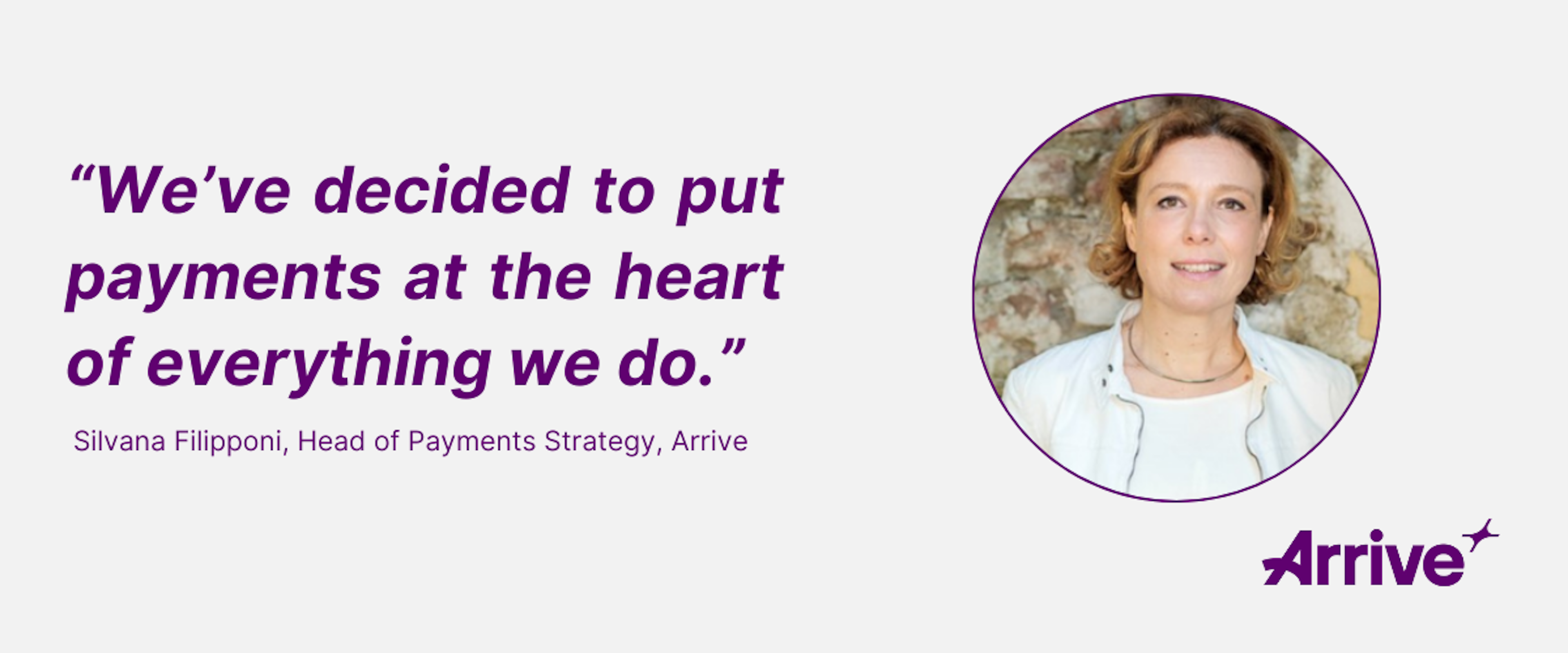
“Whether you’re parking, charging your EV, or traveling on public transport, paying for these services is a crucial moment when you’re on the move. It shapes your entire mobility experience. This is why we’ve decided to put payments at the heart of everything we do.”
1. Payments are a strategic asset; not a back office function
Handling payments efficiently helps reduce costs, which is important to any company. But the business impact goes much further:
"For us, payment orchestration is a core driver of our global growth strategy. It allows us to optimize the customer experience, accelerate market entry, and intelligently manage regulatory complexity. By enabling a new payment method, we aren't just adding a button; we are unlocking a strategic opportunity to penetrate new regions, attract previously untapped customer segments, and boost the adoption of our mobility services by offering a frictionless, localized payment experience" says Silvana.
To manage this area with the focus it deserves, Arrive has established a dedicated payments business unit that integrates perspectives ranging from strategy and product development to partnerships and legal compliance.
“The business unit is no backoffice function. It’s a strategic hub that connects all the services we deliver and accelerates growth across our business,” Silvana says.
2. Every journey is different; customer expectations are the same
Tariffs change city by city. Rates and payment preferences vary between customer groups. Not to mention the legal aspect, with local regulations, as well as EU law being interpreted differently across member states. In short, global mobility payments are complex.
But none of this matters to the users. Whether they’re a visitor trying to find their way around a new city, a resident parking in the same spot every day, or a business traveler looking to charge a rental EV: they crave (and deserve) a smooth experience.
“There’s no room for redirection or friction. Users expect effortless payment, with methods they are used to, such as card, subscription, Paypal, Apple or Google Pay, or mobile solutions. And regardless of method, every payment is a chance for us to build a relationship with the user by providing a successful experience,” Silvana explains.
3. Think globally, adapt locally
A top priority for Arrive has been to create a customer experience that is globally consistent, while designed for local flexibility.
“No matter which country or city our users are in, the steps for onboarding and payment should be the same, with local rules and payment methods seamlessly integrated into a familiar ecosystem,” says Silvana.
This builds trust with the users, while allowing Arrive to scale efficiently, since there’s no need to re-invent the wheel for each new market, industry, or payment method.
4. Regulations are opportunities; not obstacles
Rather than obstacles to overcome, Arrive views changing regulations as catalysts for improvement. And according to Silvana, this brings benefits beyond mere legal compliance:
“Staying on top of regulations helps us rethink and realign how we do business across different markets. It’s an opportunity for us to be innovative and proactive in our operations.”
5. Leverage tech and collaboration
Silvana emphasizes that the right partnerships and technologies are critical for Arrival’s ability to scale at speed without sacrificing long-term resilience:
“Collaboration is key. We work very closely with customers, regulators, and partners to make sure we strike the right balance between customer experience and compliance on the one hand, and innovation and operational efficiency on the other.”
One example is Arrive’s collaboration with Billogram as a payment platform provider:
“Billogram is doing a fantastic job in providing the right technological layers for each step in the end-to-end cycle of payments – from invoice generation and distribution to SEPA mandated payment, reconciliation, and dunning. Together, we’ve created a platform that’s globally consistent but designed for local flexibility. This allows us to reach the customer where they are and let them pay in the way that feels most natural to them.”
For Silvana, this reflects how Arrive thinks about partnerships overall: agile, intentional, and outcome-focused.
“We achieve results fast, while maintaining a future-oriented focus,” she concludes.
In our on-demand webinar Techaway: The Future of Payments, Silvana Filipponi shares more learnings from Arrive’s growth journey. You’ll also get trends and insights from Billogram’s own experts, covering topics like converging payment rails, integrated invoice-to-cash flows, and responsible use of AI and automation. All of which will help you turn payments into a competitive edge.
Martin Svane